Beneficios para la piel de tratamientos con láser “Ultra Clear”
Skin benefits of “Ultra Clear” laser treatments
26 de febrero de 2026 | February 26, 2026
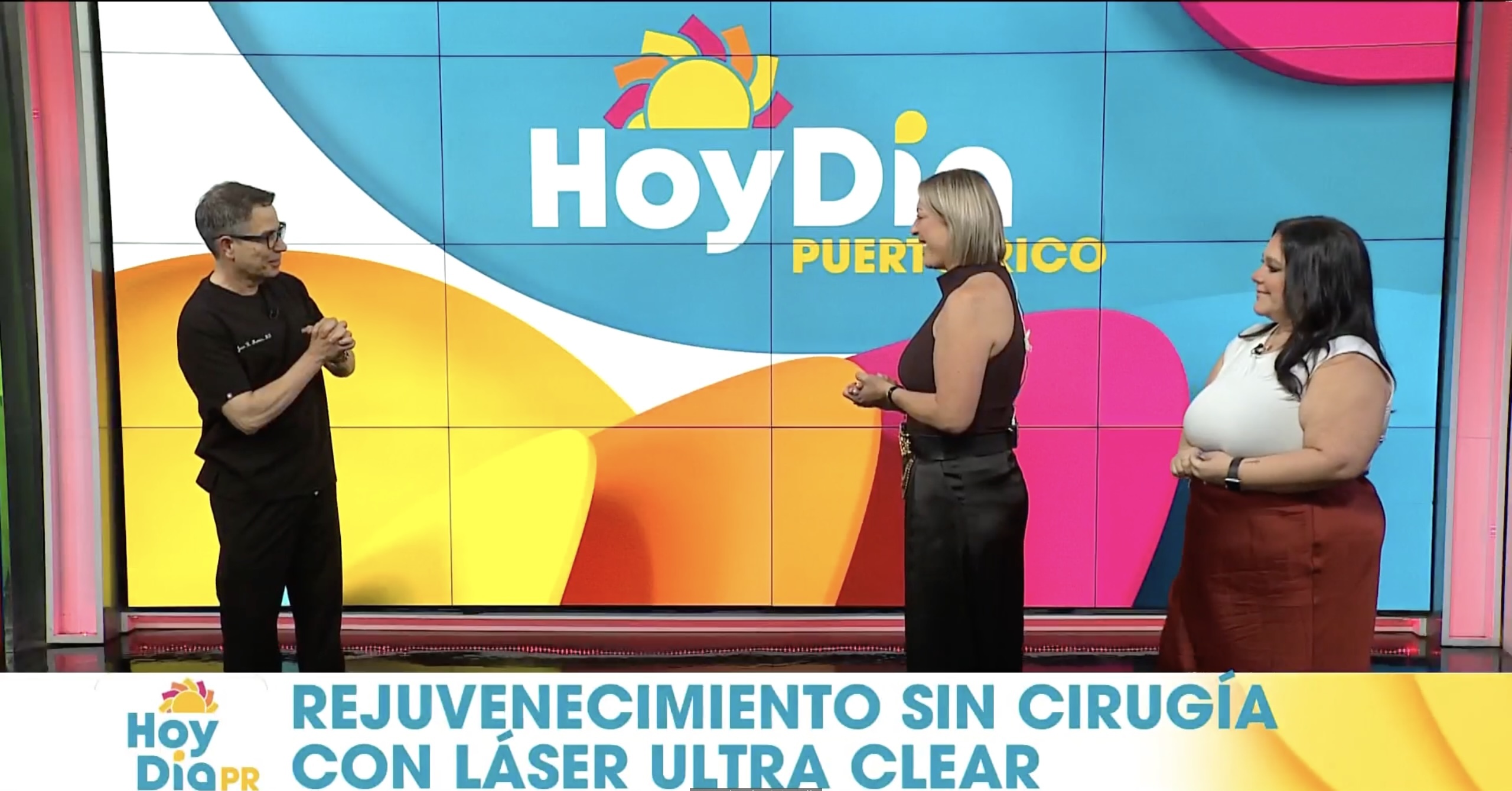
Norwill Fragoso: Quiero que sepan —y ahí toma nota Pamela— porque existe un nuevo avance de la tecnología (aprobado por la FDA) que aporta una solución innovadora al rejuvenecimiento facial sin cirugía. Lo que usted necesita.
Pamela Noa: O sea, estamos hablando del láser Ultra Clear, pero para conocer de qué se trata, cuáles son sus beneficios recibimos al Cirujano Oculoplástico, el Doctor José Raúl Montes. Buenos días.
Norwill Fragoso: Buenos días.
Dr. Montes: Buenos días, Pamela y Norwill.
Pamela Noa: Necesitamos todos esos códigos.
Dr. Montes: ¡Qué sorpresa y qué alegría estar aquí con ustedes … y con ustedes, especialmente!
Norwill Fragoso: ¡Gracias!
Dr. Montes: Bueno, vamos a hablar de un láser y les voy a decir, les voy a hacer una confesión. Tú sabes que cuándo hablamos de tecnologías nuevas, hay montones en el mercado y ustedes saben (a través de los medios sociales) que la gente se les inunda de información. Una dice que funciona, otra no funciona. Yo soy una persona que hago una investigación exhaustiva antes de incorporar algo en mi oficina y esta tecnología yo la vengo siguiendo desde que salió hace dos o tres años y vi los resultados. Fui evaluador en los tratamientos que se hicieron y ellos dijeron: esto yo lo que quiero para mi práctica, porque lo quiero para mí también. O sea, so de estas cosas que tú incorporas para ti.
Pamela Noa: … Y el doctor habla claro, o sea, si no funciona, pues o funciona.
Dr. Montes: Exactamente.
Norwill Fragoso: Entonces, ¿qué es lo que hace particular esta técnica?
Dr. Montes: Esta técnica, yo creo que podemos ver un video, porque no tenemos tanto tiempo para que vean cómo funcionan y voy a hablar sobre este vídeo. Desde hace veinte años, se están hablando de láseres que actúan básicamente creando calor y energía sobre la piel. Estos láseres de CO2 se conocen como láseres ablativos (es decir, queman, producen un gran efecto,) pero la desventaja es que la recuperación de esto es larga y tediosa y dolorosa para el paciente. Ha pasado. Me ha pasado y yo he utilizado este laser de CO2 por veinte, veinticinco años. Sin embargo, cuando yo veo un láser que es capaz de reproducir resultados con una eficacia aún mayor, increíble, donde el paciente apenas siente dolor, la recuperación es rápida y se hace en corto tiempo. Esto se llama Ultra Clear, que es una fibra.
Pamela Noa: Okay Doctor, tenemos muchas preguntas.
Dr. Montes: Estos son microcanales.
Pamela Noa: Mira la diferencia.
Norwill Fragoso: Es brutal.
Pamela Noa: Sí. Okay, doc. Cuando usted dice que la recuperación es más rápida de cuánto tiempo más o menos. Estamos hablando, me imagino, que depende de la persona, pero más o menos.
Dr. Montes: Yo hago el láser de CO2 todas las semanas, por lo menos dos veces a la semana, en varios pacientes y tienen resultados increíbles, pero la recuperación toma cuatro, seis meses, paraque el color de la piel regrese a lo que era antes. Este paciente, miren este paciente en un antes y después (cinco meses después), la recuperación de este paciente. El propósito para este paciente era para mejorar, recoger parte del tejido periocular que tiene pérdida de elasticidad, pero este laser lo que tiene es que es bien versátil. Tú quieres hoy día —y esto tú lo entiendes muy bien, Pamela y Norwill también— porque lo hemos hablado. Si hoy día el rejuvenecimiento facial no se trata de tratar de estar inyectándose cosas en la cara y estar creciendo en la cara y no verse natural. Se trata de verse natural y esto es lo que se conoce como prejuvenation. ¿Por qué? Porque lo principal —y todos los sabemos— es la piel. Ahí está la clave de verse bien a través de todas las décadas de tu edad.
Norwill Fragoso: Una pregunta, ¿a qué edad es recomendable someterse a este tratamiento?
Dr. Montes: Okay, tremenda pregunta. Si tú lo que quieres es mejorar la textura de la piel (tú tienes un problema como éste), tú puedes hacerte este láser desde los veinte, treinta años. Si tú eres una persona aún más joven que tiene una cicatriz en la piel por algún accidente, se puede hacer el láser también una edad más joven.
Pamela Noa: ¿Y entonces Doctor? Voy a traer mi caso porque sé que probablemente hay muchas personas que nos están viendo les pasa lo mismo. En mi caso, me piel es ultra sensitiva (es rosácea), o sea, que ya de por sí se me hincha, se me seca, etcétera. Una persona como yo es candidata para hacerse un láser.
Dr. Montes: Tú lees mentes, porque de eso iba a hablar yo ahora. Esto es otra de las maravillas de este laser. Nosotros todos tenemos fototipos de piel. Tenemos de I a V —para que tengan una idea— y los puertorriqueños aquí somos tipo III, tipo IV. Eso quiere decir que, si vamos a la playa, pues nos vamos a broncear un poquito. Tal vez nos quemamos un poco. Tipo IV se broncea mas fácil, se quema menos. El tipo V de piel casi nunca se quema y se broncea y el VI siempre se broncea (es decir, son las pieles más oscuras). Antes los láseres estaban prohibidos para pieles que fueran superior a tipo III. Es decir, se crearon todas estas tecnologías para la población caucásica nórdica solamente y esa tecnología esta ideada para cubrir todos los tipos de piel, condiciones de piel inflamatorias (como la que tú tienes, que es una rosácea leve y muy bien controlada).
Pamela Noa: Gracias. Estamos trabajando en ella.
Dr. Montes: Así es que en resumen por fin tenemos una tecnología (el láser Ultra Clear) que te puede dar resultados increíbles en un tratamiento cómodo, poco doloroso, la recuperación es corta.
Norwill Fragoso: ¡Brutal; eso está brutal! ¡Me encanta! ¡Queremos diez para llevar!
Pamela Noa: ¡Buenísimo; buenísimo!
Pamela Noa: Ahí usted tiene las redes sociales y también el website.
Norwill Fragoso: ¡Muchas gracias, Doctor!
Dr. Montes: Un placer
Norwill Fragoso: I want you all to know —and take note here, Pamela— that there is a new technological advancement (approved by the FDA) that offers an innovative solution for non-surgical facial rejuvenation. It is exactly what you need.
Pamela Noa: In other words, we are talking about the Ultra Clear laser, but to find out exactly what it entails and what its benefits are, we are joined by Oculoplastic Surgeon Dr. José Raúl Montes. Good morning!
Norwill Fragoso: Good morning!
Dr. Montes: Good morning, Pamela and Norwill!
Pamela Noa: We need all those insider tips!
Dr. Montes: What a surprise, and what a joy it is to be here with you … and with all of you watching, especially!
Norwill Fragoso: Thank you!
Dr. Montes: Well, we are going to talk about a laser, and I have a confession to make. You know that whenever we talk about new technologies, there are tons of them on the market, and as you know (thanks to social media), people get absolutely flooded with information. One claims to work, the other one does not, but often, they just do not work. I am someone who conducts exhaustive research before incorporating anything into my practice. I have been tracking this specific technology since it first launched two or three years ago, and I have seen the results firsthand. I served as an evaluator during the clinical trials, and I remember telling myself: «This is exactly what I want for my practice —because I want it for myself, too.» In other words, it is one of those things you incorporate because you want to use it on yourself.
Pamela Noa: … And the doctor speaks candidly: either it works, or it does not.
Dr. Montes: Exactly.
Norwill Fragoso: So, what is it that makes this specific technique so unique?
Dr. Montes: Regarding this technique —I think we can roll a video now, since we do not have a lot of time— so you can see how it actually works. I will provide commentary over the footage. For the past twenty years, the conversation around lasers has centered on devices that function primarily by generating heat and energy within the skin. These CO2 lasers are known as “ablative” lasers —meaning they essentially burn the tissue to produce a dramatic effect— but the major downside is that the recovery process is long, tedious, and painful for the patient. That has been the reality until now. It has happened to me, and I have been using this CO2 laser for twenty, twenty-five years. However, when I see a laser capable of reproducing results with even greater efficacy, incredible, where the patient feels hardly any pain, recovery is quick, and the procedure itself is completed in a short amount of time. This is called Ultra Clear, which utilizes a fiber-optic delivery system.
Pamela Noa: Okay, Doctor, we have a lot of questions.
Dr. Montes: These are micro-channels.
Pamela Noa: Look at the difference.
Norwill Fragoso: It is incredible.
Pamela Noa: Yes. Okay, Doc. When you say the recovery is faster, roughly how long are we talking about? I imagine it depends on the individual, but just a ballpark figure.
Dr. Montes: I perform CO2 laser treatments every week, at least twice a week, on various patients, and they achieve incredible results. However, recovery takes four to six months for the skin tone to return to what it was before. Take this patient, for instance —look at this patient in this «before and after» comparison (five months later)— look at this patient’s recovery. The objective for this specific patient was to improve and tighten some of the periocular tissue —the skin around the eyes— which had lost its elasticity. The great thing about this laser is that it is incredibly versatile. Nowadays —and you understand this very well, Pamela, as does Norwill— because we have discussed it before … nowadays, facial rejuvenation is not about constantly injecting things into your face, making your features look unnaturally inflated, or failing to look natural. It is about looking natural, and this is what is known as «prejuvenation.» Why? Because the most important factor —as we all know— is the skin itself. That is the key to looking your best throughout every decade of your life.
Norwill Fragoso: One quick question: at what age is it recommended to undergo this treatment?
Dr. Montes: Okay, excellent question. If your goal is simply to improve your skin texture —if you have a specific issue like the one shown here— you can undergo this laser treatment starting in your twenties or thirties. If you are a much younger person who has a scar resulting from an accident, laser treatment can also be performed at a younger age.
Pamela Noa: So, Doctor? I am using my own situation as an example, because I know that many people watching us are probably dealing with the same thing. In my case, my skin is ultra-sensitive (rosacea) which means that, by its very nature, it tends to swell, dry out, and so on. Would a person like me be a candidate for laser treatment?
Dr. Montes: You must be a mind reader, because that is exactly what I was about to discuss. This is yet another one of the wonders of this laser. We all have specific skin phototypes. They range from I to V —just to give you an idea— and here in Puerto Rico, we tend to be type III or type IV. That means that if we go to the beach, we will likely get a bit of a tan. We might get a little sunburned, too. Type IV skin tans more easily and burns less often. Type V skin almost never burns —it just tans— and type VI skin always tans (meaning, these are the darkest skin tones). In the past, lasers were off-limits for skin types higher than type III. In other words, all these technologies were originally created exclusively for the Nordic Caucasian population; however, this specific technology is designed to treat all skin types, as well as inflammatory skin conditions (such as the one you have—mild, very well-controlled rosacea).
Pamela Noa: Thank you. We are working on it!
Dr. Montes: So, in summary, we finally have a technology —the Ultra Clear laser— that can deliver incredible results through a comfortable, relatively painless treatment with a short recovery time.
Norwill Fragoso: That is awesome! That is awesome! I love it! We will take ten to go!
Pamela Noa: Fantastic! Just fantastic!
Pamela Noa: You can find his social media handles and website right there on the screen.
Norwill Fragoso: Thank you so much, Doctor!
Dr. Montes: My pleasure.